
In late 2024, former Intel CEO Pat Gelsinger made headlines by stating that quantum computing could eventually make traditional GPUs—and much of today’s AI infrastructure—obsolete. The comment sparked heated debate across tech forums, Reddit, and X.
While quantum computers are undeniably powerful, the reality is far more nuanced: quantum computing will not replace GPU and AI systems in the foreseeable future. Instead, it will complement them, creating a hybrid future where each technology plays to its unique strengths.
This article breaks down why the “replacement” narrative is overstated, how quantum and classical systems (especially GPUs) will work together, and what this hybrid era means for developers, businesses, and investors.
What Are Quantum Computers and How Do They Differ from GPUs?
To understand the debate, we first need clear definitions.
A traditional computer—including the powerful GPUs that drive modern AI—uses bits, which are either 0 or 1. GPUs process billions of these bits in parallel, making them ideal for the matrix multiplications behind deep learning.
A quantum computer uses qubits. Thanks to superposition and entanglement, a qubit can represent 0, 1, or any proportion of both states simultaneously. This gives quantum systems exponential advantages for very specific problems—but not for everything.
Key Differences at a Glance
- GPUs excel at parallel floating-point arithmetic (perfect for training neural networks)
- Quantum computers excel at massive combinatorial search, optimization, and simulating quantum systems
- Current quantum machines have only hundreds of noisy qubits; fully error-corrected systems are still years away
- GPUs are mature and affordable, with steady performance improvements year after year
Why Pat Gelsinger’s Claim Sparked Controversy
Gelsinger’s remarks came during a period of intense competition between Intel, NVIDIA, AMD, and new quantum players like IBM, Google, and IonQ. Some interpreted his statement as a defensive move to downplay NVIDIA’s AI dominance.
However, most quantum experts consistently emphasize collaboration rather than replacement.
Leading Voices on Hybrid Computing
- Jack Hidary (SandboxAQ): “The 2030s will be the decade of GPU-quantum hybrid algorithms.”
- Krysta Svore (Microsoft): “Useful quantum advantage will first appear as a co-processor model, similar to how GPUs became AI accelerators.”
- John Preskill (Caltech): Describes the next 10–15 years as the “NISQ + GPU” era.
Why Quantum Computing Will Not Replace GPU and AI Anytime Soon
1. Error Rates and Scalability Remain Major Hurdles
Today’s quantum computers are noisy intermediate-scale (NISQ) devices. Even Google’s 2023 breakthroughs required massive classical post-processing—often on GPUs—to make sense of results.
2. Most AI Workloads Are Not Quantum-Friendly
Training large language models, computer vision systems, and recommendation engines rely heavily on gradient descent and backpropagation. These algorithms gain little to no speedup on pure quantum hardware.
3. Hybrid Algorithms Already Dominate
Algorithms such as Quantum Phase Estimation (QPE), QAOA, and VQE require tight integration with classical optimizers running on CPUs and GPUs.
4. Economic Reality
A high-end NVIDIA H100 GPU cluster costs millions but delivers immediate value.
Fault-tolerant quantum systems capable of outperforming GPUs on real-world tasks will likely require millions of physical qubits—a milestone estimated to be 10–20 years away.
How Quantum Computing Will Complement GPUs and AI
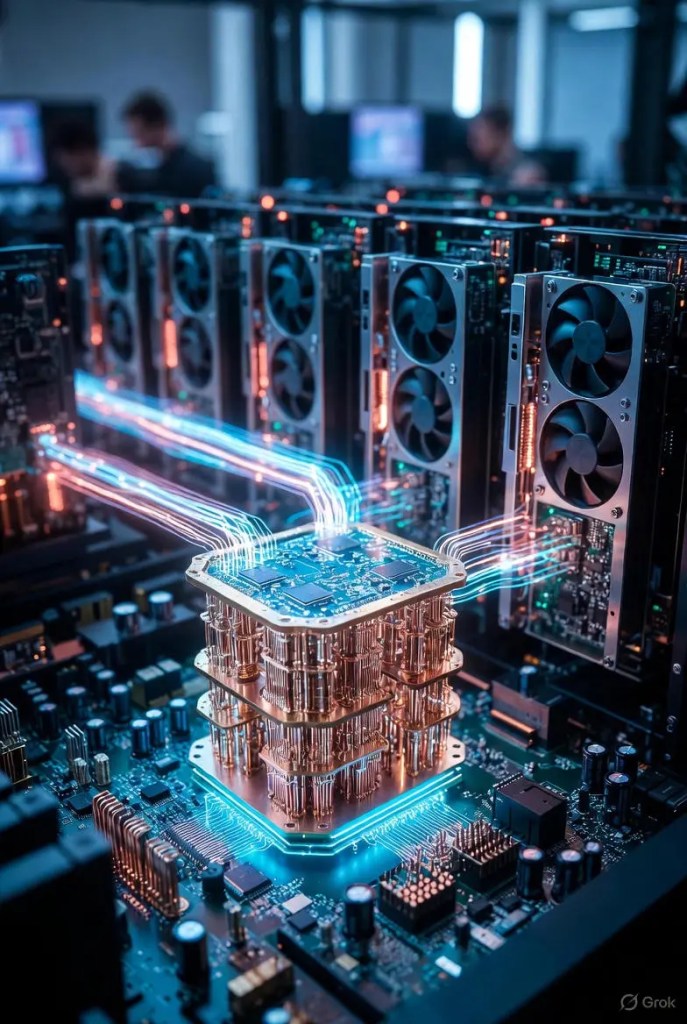
The real future is co-processing. Think of quantum computers as the next generation of accelerators, sitting alongside GPUs the way GPUs once sat alongside CPUs.
Real-World Hybrid Use Cases Emerging Today
- Drug discovery: Quantum chemistry simulation (quantum hardware) + molecular docking & protein folding (GPUs)
- Financial portfolio optimization: QAOA for scenario sampling + classical risk models on GPUs
- Logistics & supply chain: Quantum-inspired optimization + GPU-driven reinforcement learning
- Cryptography & security: Quantum key distribution + GPU-accelerated post-quantum cryptography testing
Major Cloud Providers Building the Hybrid Future
- AWS Braket Hybrid Jobs allow quantum circuits to run alongside classical GPU compute
- Azure Quantum integrates IonQ, Quantinuum, and NVIDIA cuQuantum GPU emulation
- Google Cirq + NVIDIA cuQuantum enables simulation of thousands of qubits on GPU clusters today
What This Hybrid Future Means for You
For Developers and Data Scientists
Start learning hybrid programming now. Tools such as PennyLane, Qiskit Aer (GPU backend), and CUDA Quantummake it easier than ever to run variational algorithms across both systems.
For Businesses and Investors
Companies that master GPU-quantum workflows early will gain massive advantages in chemistry, materials science, and optimization-driven industries. Early movers include JPMorgan Chase, ExxonMobil, and Merck.
For Everyday AI Users
Nothing changes overnight. ChatGPT, Midjourney, autonomous driving, and general AI systems will continue improving on classical hardware for at least the next decade.
Frequently Asked Questions
Will quantum computers ever make GPUs obsolete?
No. Not for general-purpose computing or most AI training. Quantum systems will handle niche, exponentially hard problems while relying on GPUs for everything else.
When will we see practical quantum advantage?
Between 2028–2035, and almost always in hybrid form.
Should I stop investing in NVIDIA or AI stocks because of quantum?
No. Analysts overwhelmingly agree quantum tech complements, rather than replaces, classical AI infrastructure.
Conclusion: A Collaborative, Not Competitive, Future
Pat Gelsinger’s bold claim grabbed attention, but the evidence points clearly in another direction: quantum computing will not replace GPU and AI infrastructure—it will supercharge it.
The winning architecture of the 2030s and beyond will be hybrid classical-quantum systems, with GPUs remaining the workhorse for the vast majority of computation.
The smartest move today:
Embrace both worlds. Learn quantum basics, experiment with hybrid cloud tools, and prepare for the most exciting decade in computing history.


